4WD Recovery Gear Essentials and How to Use It Safely
Disclosure: As an Amazon Associate, OutbackKit earns from qualifying purchases. Some links on this page are affiliate links, so we may earn a small commission if you buy through them, at no extra cost to you. We only point to gear we’d be happy to take on our own trips.
Everyone gets stuck eventually. Sand, mud and washouts catch out experienced drivers too. What matters is having the right gear, knowing how to use it, and recovering without anyone getting hurt. Recovery equipment stores enormous energy under load, and when something fails it can be lethal. Take this seriously.
This guide is general information only. We strongly recommend a hands-on 4WD training course before you head off-road.
Step zero: avoid getting stuck
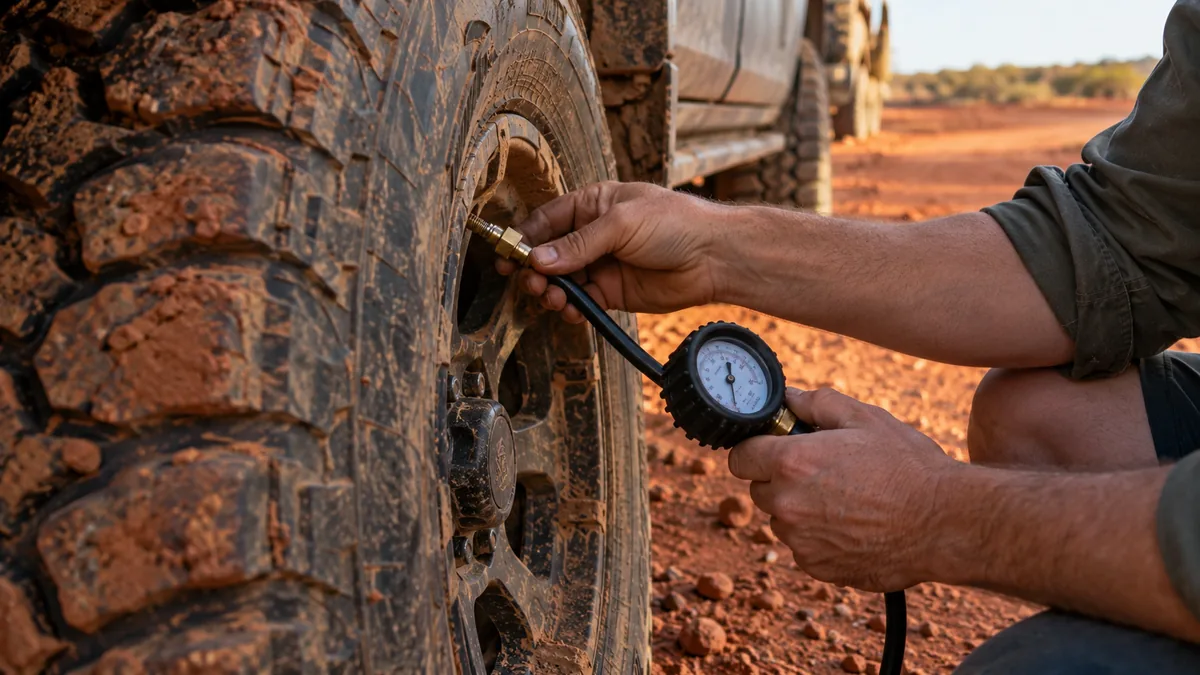
- Lower your tyre pressures for sand and soft tracks, using a gauge, and reinflate before returning to hard roads. Follow your tyre and vehicle manufacturer’s guidance.
- Walk the track if you’re unsure about a crossing or a sandy climb.
- Choose the right gear and engage 4WD before you need it.
- Don’t travel alone on hard tracks if you can avoid it.
The essential recovery kit
1. Tyre deflator and pressure gauge
A quick, accurate way to let air out of your tyres. Correct pressures prevent more bogs than any other piece of gear. (tyre deflators on Amazon)
2. Air compressor
To reinflate tyres after the sand. A quality 12V compressor wired directly to the battery saves a lot of time. (air compressors on Amazon)
3. Recovery boards (traction boards)
Placed in front of or behind the wheels to give the tyres something to grip. They are often the simplest and safest self-recovery for sand and mud. (recovery boards on Amazon)
4. Long-handled shovel
For digging out sand around the tyres and in front of the diffs, which is often half the job.
5. Snatch strap or kinetic rope
Used to recover a bogged vehicle with another vehicle. Its stretch stores energy, which is what makes it effective and also what makes it dangerous. Pick a strap rated appropriately for your vehicle’s weight. Under Australia’s mandatory standard, the strap’s minimum breaking strength should be 2 to 3 times the GVM of the lighter of the two vehicles. (snatch straps on Amazon)
6. Rated recovery points
Never attach a strap to a tow ball or a tie-down point. Use only rated recovery points fitted to the vehicle chassis. (rated recovery points on Amazon)
7. Soft shackles or rated bow shackles
To connect straps to recovery points. Soft shackles are lighter, so they carry less energy if something lets go. Only use rated shackles, and never exceed their working limit.
8. Recovery dampener
A weighted blanket or bag draped over the middle of a strap or winch line. It helps absorb energy if the line breaks.
9. Gloves
For handling straps, cables and hot or sharp parts.
10. Tree trunk protector and equaliser strap
If you have a winch: they protect trees and allow safer anchor setups.
Nice-to-haves as you progress
- Winch with a synthetic rope, plus a snatch block (winches on Amazon)
- Hi-lift or exhaust jack, with proper training
- Ground anchor for winching where there are no trees
- Tyre repair kit, plus a second spare tyre for remote trips
Recovery safety rules
- Stop and assess. Don’t keep spinning the wheels. This digs you in deeper and can damage the vehicle.
- Try the simplest option first: lower tyre pressures, dig, and use recovery boards. A gentle recovery is a safe recovery.
- Clear the area. Keep everyone not directly involved well away, at a distance well beyond the length of the strap, and never stand in line with it.
- Use only rated gear and rated recovery points. If you’re unsure of a point’s rating, don’t use it.
- Inspect straps before each use, and retire any that are cut, frayed, burnt or contaminated.
- One person in charge, with clear agreed signals, or UHF radios between drivers.
- Never join two snatch straps with a metal shackle.
- Use a dampener on every strap or winch recovery.
- Don’t use a strap to “jerk” the vehicle out with a run-up beyond what’s needed. Build up gradually.
Practise before you need it
Learn the gear somewhere safe and easy: a beach access track or a 4WD park with a training course. Recovering a vehicle for the first time in fading light, in remote country, with an audience, isn’t the time to read instructions.
Top of the line vs best value
Well-known options sold in Australia, if you want a starting point. We haven’t independently tested every one, prices change often, and the right choice depends on your trip, so check current prices, specs and warranty before buying. Not ready to buy? Pop it in your Amazon cart so it’s there when you are.
Recovery boards
- Top of the line: MAXTRAX MKII recovery boards on Amazon · Add to Amazon cart: premium, well-known Australian recovery boards.
- Best value: BASHIK traction mats on Amazon · Add to Amazon cart: budget-friendly traction mats for lighter recovery jobs.
Tyre deflators
- Top of the line: Staun Automatic Tyre Deflators Heavy Duty on Amazon · Add to Amazon cart: premium automatic deflators.
- Best value: ATsafe 2-in-1 rapid tyre deflator on Amazon · Add to Amazon cart: budget-friendly manual deflator with a gauge.
Further reading
- 4WD tyre pressures and tyre care
- Beach camping and sand driving
- First aid and emergency comms for remote camping
- Packing and organising a 4WD
The bottom line
A tyre gauge, deflator, compressor, recovery boards, shovel, a correctly rated snatch strap, soft shackles, rated recovery points and a dampener cover the vast majority of recoveries. Add training and good judgement, and you’re well prepared.