Home › Camp Furniture & Comfort
Choosing a Headtorch and Camp Lighting
Disclosure: As an Amazon Associate, OutbackKit earns from qualifying purchases. Some links on this page are affiliate links, so we may earn a small commission if you buy through them, at no extra cost to you. We only point to gear we’d be happy to take on our own trips.
Good lighting makes camp safer and more comfortable, from cooking after dark to finding the toilet at 2am. But too much light ruins the night sky and annoys your neighbours. Here’s how to choose a headtorch and camp lighting that does the job without lighting up the whole campground.
Lumens explained in plain terms
Lumens measure how much light a torch puts out in total. More lumens means brighter, but brighter isn’t always better.
- Low output is plenty for reading, inside the tent and moving around camp without dazzling people.
- Medium output suits cooking, setting up and walking on tracks.
- High output is useful for spotting things in the distance, searching for something dropped, or emergencies, but it drains batteries quickly and dazzles everyone around you.
Other things matter as much as lumens:
- Beam type: a flood (wide) beam is better for camp tasks, while a spot (narrow) beam reaches further. Many headtorches offer both.
- Run time: manufacturers’ figures can vary in how they’re measured, and the brightest setting usually runs for much less time.
- Brightness regulation: some torches stay at a steady brightness, while others gradually dim as batteries drain.
Headtorches
A headtorch keeps your hands free, which is why it’s the single most useful light at camp.
What to look for
- Several brightness levels, including a low mode
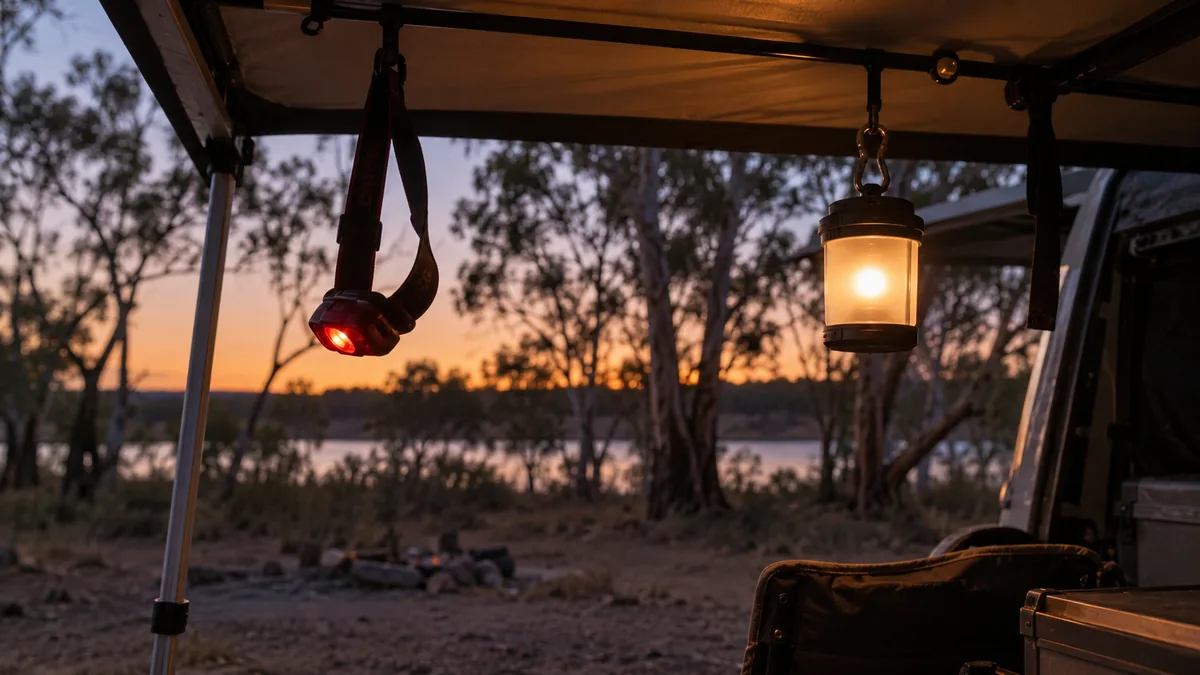
- Red light mode to preserve night vision and avoid dazzling others
- Comfortable strap and a tilting lamp
- Water resistance, given as an IP rating
- Lockout feature, so it doesn’t turn on in your bag and drain the battery
- Easy-to-use buttons, even with gloves
(headtorches on Amazon) (rechargeable headtorches on Amazon)
Red light mode
Your eyes take time to adjust to the dark, and white light resets that instantly. Red light lets you see nearby without losing your night vision, and it’s far kinder to people around you. It’s the mode to use around camp at night, and it’s essential for stargazing and night photography.
Batteries vs rechargeable
Disposable batteries (AA/AAA)
- Easy to find, and you can carry spares
- Useful on long remote trips without charging
- Ongoing cost and waste
Built-in rechargeable
- Convenient and cheaper to run over time
- Can be recharged from a power bank, vehicle USB or solar
- When it’s flat, it’s flat, unless you have a way to charge it
Hybrid
- Some torches take a rechargeable pack or standard batteries, which is a good compromise for remote travel
Cold weather reduces battery performance, so keep your headtorch in your sleeping bag on cold nights. Carry a spare light or batteries on longer trips. (power banks on Amazon)
Lanterns
Lanterns light up an area: a table, a tent or a camp kitchen.
- LED lanterns are the most common. They’re safe in tents and don’t get hot. (LED lanterns on Amazon)
- Dimmable lanterns let you set the right level.
- Warm colour (yellower light) is more pleasant than harsh blue-white light, and may attract fewer insects.
- Hanging hooks help light a whole area from above.
- Fuel lanterns (gas or liquid fuel) give bright light and warmth, but are a fire and carbon monoxide risk. Never use them inside a tent or enclosed space.
Strip lights and vehicle lighting
- LED strip lights fixed under an awning or along a tailgate give even light over a large area. (LED strip lights on Amazon)
- Many run on 12V from a dual battery or power station. See 12V and solar basics.
- Orange or amber lights are popular as they may attract fewer insects.
Camp lighting etiquette
Lighting is one of the most common causes of campground friction.
- Point lights down, not out across the campground.
- Use the lowest brightness that does the job.
- Use red light when walking around camp at night.
- Don’t shine headtorches at people’s faces. Look down or tilt the lamp when talking to someone.
- Turn lights off when you’re not using them, especially late at night.
- Avoid bright floodlights in shared campgrounds.
- Remember the stars. Light pollution washes out the night sky, which is one of the best parts of camping.
Safety tips
- Always pack a headtorch for every person, plus a backup light.
- Keep a torch in the same spot in the tent so you can find it in the dark.
- Kids love their own headtorch, and it makes night toilet trips easier.
- Never use flame lanterns or heaters inside tents.
Lighting checklist
- Headtorch for each person, with red mode
- Spare batteries or a power bank
- Dimmable LED lantern for camp
- Awning or strip light (optional)
- Backup torch in the vehicle
Top of the line vs best value
Well-known options sold in Australia, if you want a starting point. We haven’t independently tested every one, prices change often, and the right choice depends on your trip, so check current prices, specs and warranty before buying. Not ready to buy? Pop it in your Amazon cart so it’s there when you are.
Headtorch
- Top of the line: Ledlenser H5R Work headtorch on Amazon · Add to Amazon cart: premium, bright and rechargeable.
- Best value: Black Diamond Spot on Amazon · Add to Amazon cart: budget-friendly, well-reviewed all-rounder.
Further reading
The bottom line
Choose a comfortable headtorch with a low and a red mode, add a dimmable warm-coloured lantern for camp, sort out charging or spare batteries, and keep your lights low and pointed down. You’ll see what you need to, and so will the stars.